Tender Intelligence turns EU & German procurement tenders into structured, searchable data — and
scores every lot against your profile. This is a working demo built on the production stack: TanStack
Start · PostgreSQL/pgvector · Claude. The approach to accuracy is architectural, not prompt-tuning.
Reading one tender is easy. Reading 75 of them correctly is the job.
Official procurement documents are long, structured, multilingual, and split into lots.
General-purpose extraction gets to ~80% — close enough to look right, wrong often enough to miss a deadline or a
qualifying criterion. Closing that last gap is an engineering problem, solved with retrieval and evaluation, not
cleverer prompts.
How it works
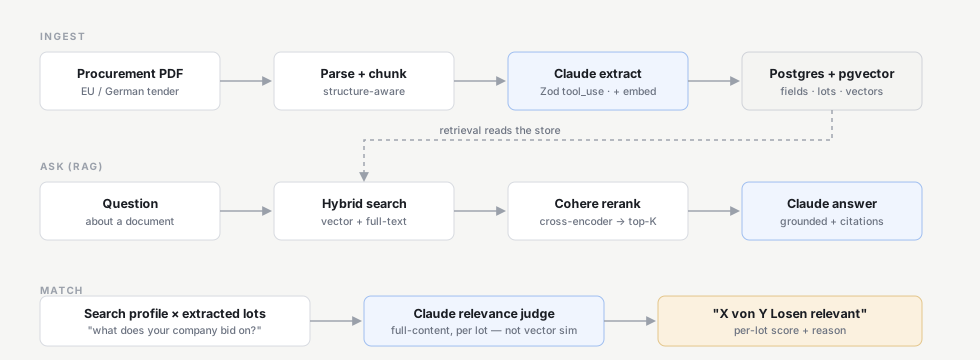
Three pipelines: ingest, ask, match.
Ingest
PDF → structure-aware chunking → Claude tool-use extraction (one Zod schema is the source of truth) +
OpenAI embeddings → Postgres/pgvector.
Ask
Hybrid search (vector + Postgres full-text) → Cohere cross-encoder rerank → a grounded Claude answer with
source citations.
Match
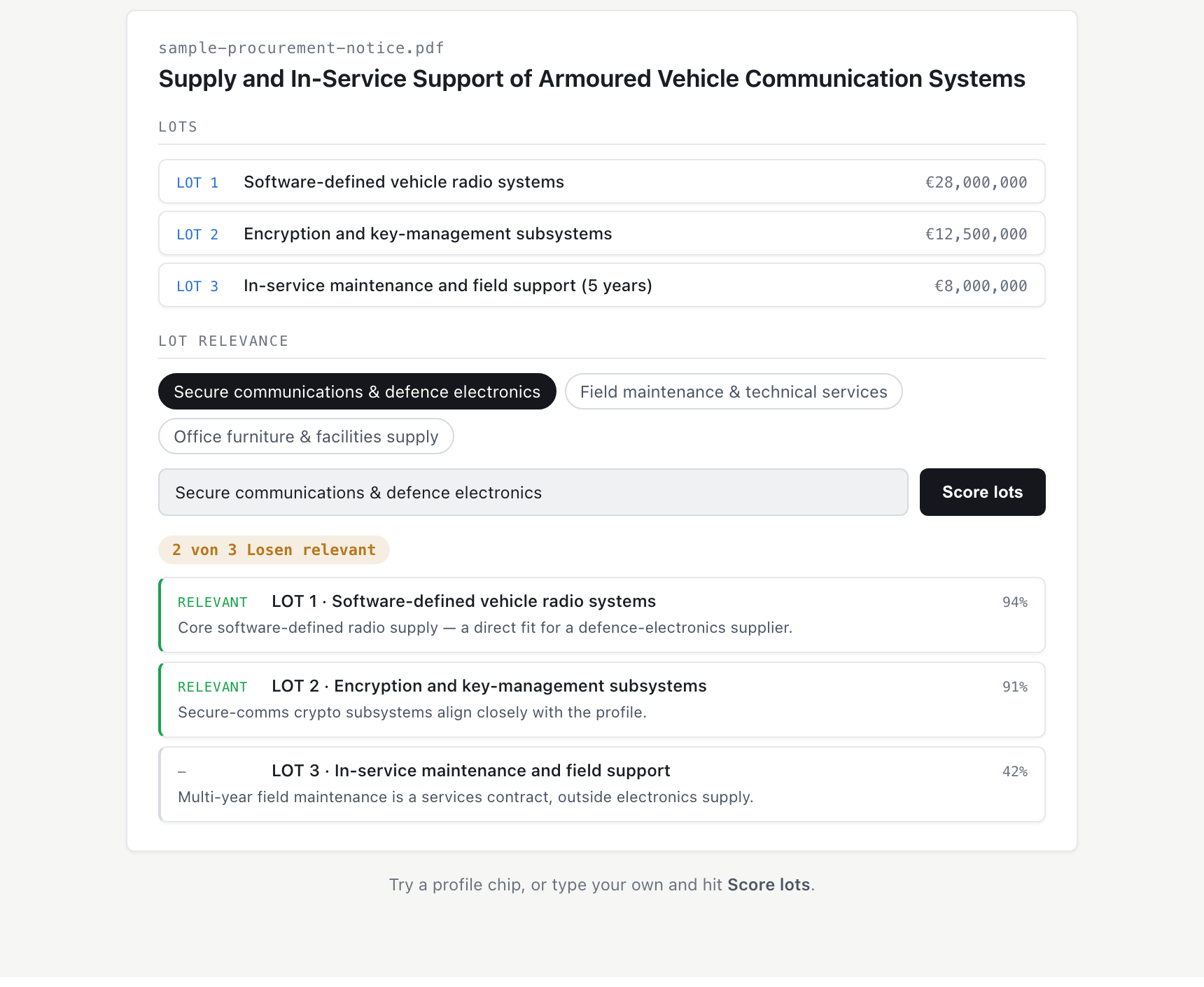
Each lot judged on its full content against a search profile — not vector similarity — producing the
relevance metric below.
The metric that matters
Per-lot relevance: X von Y Losen relevant
A buyer's profile and a tender lot can share vocabulary without being a real fit. So relevance is
an LLM judge over the full lot content — assessing genuine fit, with a score and a one-line reason per lot —
rather than an embedding-similarity guess.
Stack
The same tools, end to end.
Framework
TypeScript, React 19, TanStack Start (SSR, server functions on Vite)